
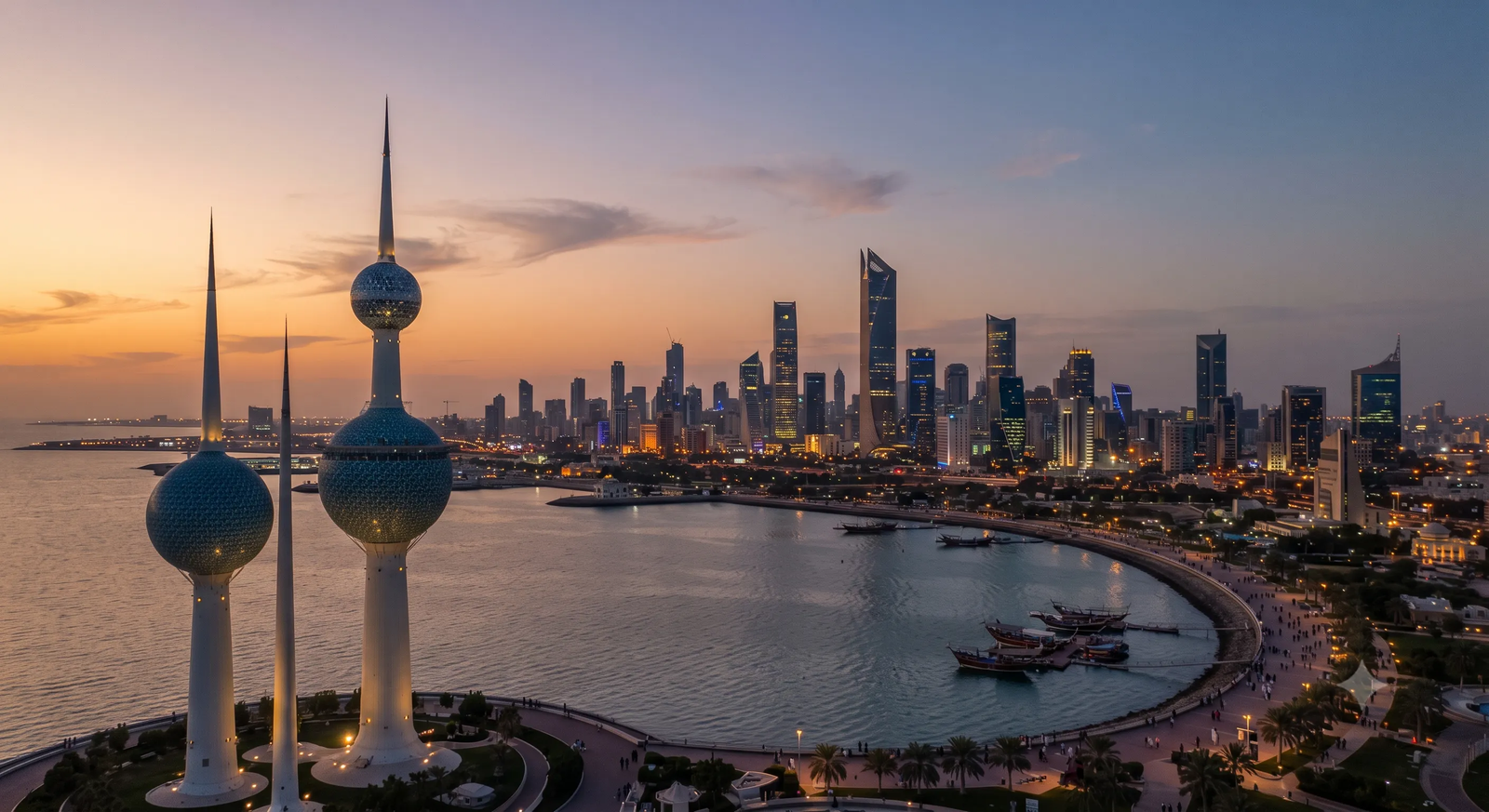
From a small fishing settlement called Grane to a seat of parliament, Kuwait City carries three centuries of change in a few square kilometres.
KUWAIT CITY, October 2026 - Kuwait City is the capital of Kuwait and the seat of its parliament, most government offices and the head offices of major banks and companies. It sits on the Gulf coast, where a walled port once stood before an oil-era master plan removed the walls in 1957.
The city is in the news for two reasons. Reconstruction of Souq Al-Mubarakiya, damaged by fire in 2022, was still being inspected in September 2025, and a new museum and arts district has opened across the capital since 2018.
Key facts about Kuwait City
| Location | Capital of Kuwait, in Al Asimah (Capital) Governorate, near the centre of the country on the Gulf shore. |
|---|---|
| Distance | Kuwait International Airport is reported at 15 to 16 km south of the centre, about 20 minutes by road. |
| Access | Buses (Kuwait Public Transportation Company, City Bus and Mowasalat are reported), taxis and rental cars. |
| Season | Arid climate with very hot summers, little rain and frequent dust storms. A travel site reported 28 to 47°C on 18 September 2026. |
| Typical visit | One to two days covers the main landmarks. |
| Main costs | Kuwait Towers viewing deck reported at about 3 KD (Kuwaiti dinars). Grand Mosque tours reported as free. As of October 2026. |
How Kuwait City developed
Sources agree that the city began as a small fishing and trading settlement known as Grane or Qurain. The name is described as a diminutive of words for a hill and a fortress. Local tradition credits Sheikh Barrak of the Bani Khalid tribe with building a fort there before the 18th century.
The founding date is disputed. A Kuwait Times history article gives about 1713 as the best estimate, while another timeline dates the start of Al-Sabah rule to 1752. The Danish traveller Carsten Niebuhr mapped the place as Grane in 1765, which shows it already existed.
Walls then shaped daily life. A first wall is dated to about 1789, and Kuwait ended up building three as the town grew. The last one had 26 towers, according to a heritage writer, and was completed after a clash with forces from Najd at Jahra in October 1920.
The 1957 demolition was not random. Oil income funded a master plan that replaced the mudbrick walls with radial roads, public spaces and defined zones, according to a city-history summary.
| Period | What happened |
|---|---|
| Before 1700s | A fishing settlement called Grane or Qurain forms on the coast. |
| c. 1713 or 1752 | Reported founding dates, depending on the source. |
| c. 1789 | First city wall reported. |
| 1899 | Mubarak Al-Sabah signs a treaty with the United Kingdom. |
| 1904 | John Lorimer's survey counts about 35,000 people inside the walls, as cited by historian Farah Al-Nakib. |
| 1920-1921 | Third and final wall built after the Jahra battle (sources give 1920 or 1921). |
| 1957 | Walls demolished under the first master plan. The Kuwait National Museum is founded. |
| 1962-1963 | The city joins the new Capital Governorate. The National Assembly is based here. |
| 1979 | Kuwait Towers open. |
| 1990-1991 | Iraqi occupation. The city is badly damaged and the National Museum destroyed, according to reference sources. |
| 2018 | Sheikh Abdullah Al-Salem Cultural Centre inaugurated. |
| 2022 | A fire on 31 March damages part of Souq Al-Mubarakiya. |
Kuwait City today: landmarks and what to know
The main sights sit along the Gulf Road corridor and in the old centre. These are the ones sources describe most consistently.
Kuwait Towers
Three slender towers on Arabian Gulf Street, built as water storage. The main tower is reported at 187 m, with a viewing sphere about 123 m above sea level that turns once every 30 minutes. One guide mentions photo displays about the 1990 invasion inside.
What to know: the towers closed for maintenance from March 2012 and reopened on 8 March 2016, according to a property blog. Hours and ticket prices are in the sections below.
Grand Mosque
Sources describe it as Kuwait's largest mosque, with a main hall for about 10,000 worshippers. It is reported as one of the few mosques that welcome non-Muslim visitors, through free guided tours.
What to know: it closes to visitors at prayer times and on Fridays, according to one guide. Dress modestly and expect hours to change in Ramadan.
Souq Al-Mubarakiya
A traditional market in the old centre selling dates, honey, spices, sweets, fish and meat. It also hosts two small museums, including the former first pharmacy in Kuwait.
What to know: a fire on 31 March 2022 destroyed shops in one section. Kuwait Finance House leads and funds the rebuilding of 17 buildings, with Alghanim International as contractor, according to project announcements.
Sources even disagree on the souq's age: one says at least 200 years, a project announcement says 120.
Surviving gates of the old wall
Several gates outlived the 1957 demolition and now stand in separate places, among them Al Shaab Gate in Shaheed Park, and the Shamiya, Maqsab and Jahra gates, according to a heritage blogger.
What to know: they are scattered, so check each location before you plan a route.
Kuwait National Cultural District
A project that includes Al Shaheed Park, the Sheikh Jaber Al-Ahmad Cultural Centre (an opera house described as the largest in the Middle East), Al Salam Palace and the Sheikh Abdullah Al-Salem Cultural Centre museum complex.
What to know: sources differ on whether that museum complex has four museums and 23 galleries (the exhibition designer) or six museums (visitor reviews).
How to get to Kuwait City and around it
Most visitors arrive at Kuwait International Airport on the Gazali Expressway. Public transport inside the city is by bus, with no rail link in the sources reviewed.
Public buses
Kuwait Public Transportation Company and City Bus are described as state-owned, with KPTC covering the capital on more than 30 routes. Mowasalat is also reported to run services.
Fares: one older guide reports a flat 200 fils fare inside the city. Confirm the current fare.
Taxis and rental cars
Airport taxis have their own ramp, according to a travel wiki. Avis, Budget, Dollar, Hertz and National are listed as international hire firms at the airport.
Fares: one listing quotes KD 6 to 7 from the airport to the centre, but the wording is unclear. Agree the price first.
A worked example: one day in Kuwait City
Tuesday, 13 October 2026 (a weekday, so tours and museums are more likely to be open)
- 09:00 - Grand Mosque guided tour. Reported morning windows run about 9 to 11, so arrive early and dress modestly.
- Late morning - Souq Al-Mubarakiya. Check which sections are open during reconstruction, and have lunch nearby.
- Early afternoon - the museum complex in the cultural district, allowing 2 to 3 hours, which is indoors and away from the heat.
- Late afternoon - Kuwait Towers before sunset, staying into the evening to see the lit towers. Check the local sunset time.
This is a sample plan, not an operator timetable.
Reported costs
All figures are reported by third-party listings, as of October 2026, and may have changed.
| Item | Reported cost | Note |
|---|---|---|
| Kuwait Towers viewing deck | About 3 KD per adult | Children under 4 are reported free. The waterfront is reported free to visit. |
| Grand Mosque tour | Free | No ticket booth reported, but check whether booking is required (see warning below). |
| Cultural Centre museums | 3 KD adult, 2 KD child | These were launch prices in 2018. Current prices were not verified. |
| Airport to centre by taxi | KD 6 to 7 (unclear wording) | Confirm before riding. |
| City bus | 200 fils reported | From an older guide. |
| Souq Al-Mubarakiya | No entry fee reported | Shop prices vary. |
Rules, safety and respect
- Heat and dust: summers are very hot and dust storms are frequent. A travel site rated air quality poor on 18 September 2026, so plan outdoor stops for early or late in the day.
- Mosque etiquette: dress modestly, follow staff directions and expect closures for prayer. Non-Muslims are reported not to be allowed in the inner halls of many other mosques.
- Construction zones: follow signs and barriers around the souq rebuilding area.
- Ramadan: tour hours reportedly shift and evening visits move later, so check ahead.
- Photography: ask before photographing people, and be cautious near government buildings.
Entry & Travel Notes
You need valid permission to enter Kuwait before you can see its capital. Check whether your passport appears on the list of visa-eligible countries, then review the documents usually required for a Kuwait visa.
You can then start a visa application through our assistance service. We are a private service, so always compare with the rules published by Kuwaiti authorities, including the Ministry of Interior.
What we know and what is still unclear
- Confirmed by several sources: the city grew from Grane, was walled until 1957, hosts Kuwait Towers (1979), and had its souq damaged by fire in 2022.
- Reported, limited sourcing: the 1789 first wall, the Towers' 2012-2016 closure, and the Towers' ticket price of about 3 KD.
- Unclear: the founding year, whether the souq reconstruction is finished (a November 2024 report expected completion within about six months, yet inspections continued in September 2025), and the exact Grand Mosque and Towers hours.
- Unclear: the cultural centre's location and museum count, current population, and today's bus routes and fares.
Voices and sources
This article draws on urban-history scholarship that cites a 1904 survey, Kuwait Times history coverage, an embassy outline of the city's name, and heritage writers describing the walls. It also uses project announcements from the firms rebuilding the souq, exhibition designers, travel guides and wikis, and traveller reviews.
Promotional and review pages can be inaccurate, so we treated them as reported information. No interviews were conducted and no quotes are used.
Frequently asked questions
Final thoughts
Kuwait City shows how a walled fishing port can become a modern capital within a few decades. Its landmarks are close together, but founding dates, visiting hours and the state of the souq rebuilding still vary by source, so check them before you travel.
Leave a Comment
Share your questions, feedback, or experience regarding the news.
No Comments Yet
Be the first to share your experience or ask a question.