
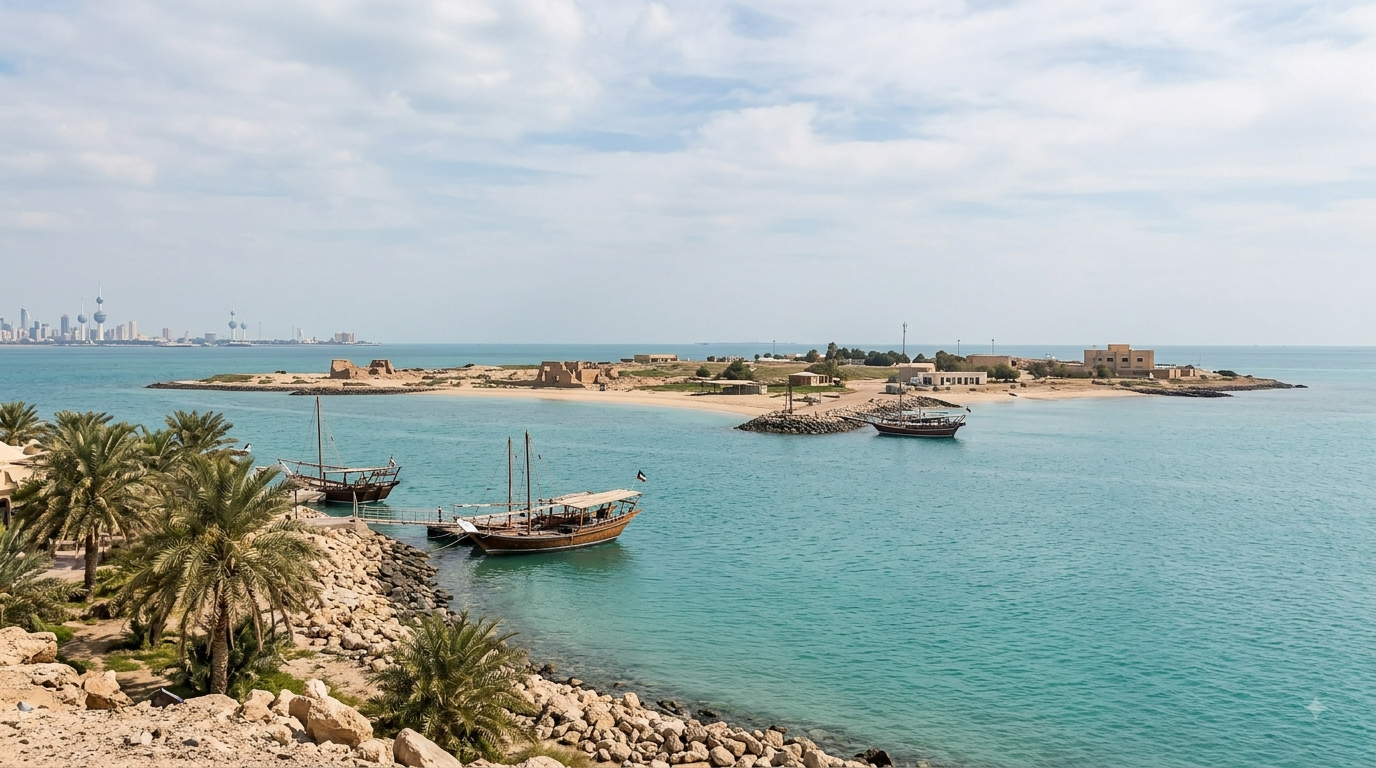
A small island off Kuwait City holds 4,000 years of layered history, and it can be visited only by boat, on timetables that shift with the tides.
KUWAIT CITY, October 2026 – Failaka Island, in the Gulf off Kuwait City, holds traces of Bronze Age Dilmun settlers, a Greek fort from the age of Alexander the Great, an early Christian monastery and a village emptied by the 1990 Iraqi invasion. Visitors can reach it by ferry or private boat, and the sailing times change from day to day.
The island matters now for two reasons. Parts of it appear on two separate UNESCO tentative-list entries, and it is the one place in Kuwait where ancient ruins and Gulf War damage stand side by side. Practical details are scattered across operators, reviews and travel guides, and they often disagree. This report separates what is confirmed from what is only reported.
Failaka Island Key Facts
| Item | Detail | Status |
|---|---|---|
| Location | An island in the Gulf, off the coast of Kuwait City | Confirmed |
| Distance from the mainland | About 20 km in UNESCO tentative-list text; some traveller sources say 30 to 44 km | Sources differ |
| Size | About 43 square kilometres | Reported |
| Access | By boat only: public ferry, private ferry or chartered boat | Reported |
| Cooler season | November to April; summers are very hot | Reported |
| Typical visit | A day trip, with about 4 to 5 hours on the island on the private ferry | Reported |
| Main cost | Return ferry around 15 KD per person; no island entry fee reported | Reported, as of October 2026 |
| Residents | Few. All inhabitants left in 1990; staff, workers and returning former residents are there today | Confirmed |
How Failaka Island Got Here
Failaka was settled after about 2000 BCE, according to archaeological summaries, and became a link in Dilmun trade between Mesopotamia and the Indus Valley. One source says Dilmun-era texts call it Agarum, the land of the god Inzak. The modern name is thought to come from a Greek word for "outpost".
The island was not abandoned by ancient history. It was emptied by a war. When Iraq invaded Kuwait in August 1990, residents fled to the mainland, and most never returned. The UNESCO tentative-list dossier notes a side effect: the abandonment protected the island from heavy development.
| Period | What happened |
|---|---|
| About 2000 BCE onward | Bronze Age settlement by Dilmun communities. Al-Khidr has pottery, seals and metal objects dated roughly 2000 to 1500 BCE. |
| 19th century BCE | Archaeologists describe the island as an important point in Dilmun operations. |
| 4th century BCE | Classical writers Strabo and Arrian say Alexander the Great's expeditions named it Ikaros. A Greek fort, temples and a harbour town followed. |
| Early centuries CE | Remains from Persian and Roman eras are also reported. At Al-Qusur, archaeologists found a monastery with two churches, built at an uncertain date. |
| 7th to 8th centuries CE | A fishing village at Al-Qurainiyah, probably the port for Al-Qusur. |
| 16th to 18th centuries | Small forts and villages. Al-Zor existed as a village from the 18th century. |
| 1930s | About 1,500 inhabitants. A sandstone inscription found in this decade was the first Greek find. |
| 1958 to 1964 | Excavations began in 1958. The Ikaros Stone was found in 1960. An archaeological museum opened on site in 1964. |
| 2 August 1990 | Iraqi forces took the island and its residents left. Much of Al-Zor was destroyed. |
| February 1991 | US forces retook the island, and about 1,400 Iraqi soldiers there were removed. It was then used for Marine training and closed to the public. |
| 21st century | A Heritage Village was built in the centre of Al-Zor, and visitors returned. |
What Is There on Failaka Island Today
Heritage Village and the Sheikh Abdullah Al-Salem Palace
The palace of Sheikh Abdullah Al-Salem Al-Sabah, built from sea stone and mud, is now the heritage museum. It stands in Al-Zor, the 20th-century town on the island's western side. Visitors report old rooms, a traditional diwaniya and a section on women's household objects. Travellers describe it as one of the better places on the island, but opening hours are not published in the sources I found.
Dilmun town at Tell Sa'ad
The Bronze Age settlement at Tell Sa'ad (site F3) includes the remains of a large open temple, thought to be dedicated to Inzak. Metal tools such as knives, hooks and farm implements point to an independent community living here. Archaeologists describe the site as part of the wider spread of Dilmun civilisation along the eastern Arabian coast.
The Greek fort and the Ikaros Stone
The Hellenistic fort and temples are the island's best-known link to Alexander's time. The Ikaros Stone, found in the ruins at site F5 in 1960, carries a long inscription. UNESCO tentative-list text calls it the only complete administrative document found in the Gulf area. Danish teams excavated these sites from 1958, and visitors on bus tours report stopping at them.
Al-Qusur monastery
In the centre of the island, archaeologists uncovered two churches with other buildings, including ones used for processing farm produce. A French mission excavated one of the churches in 1988 and 1989, just before the war. A book on the site was published in 2016. Access for casual visitors is not clearly described.
Al-Khidr
On the north-west tip, Al-Khidr is a possible Bronze Age harbour, now silted up. It takes its name from a modern shrine to al-Khidr, which one source reports was demolished. Look for it on guided tours rather than on foot, since the sites are spread out.
Gulf War remains
An open-air display of tanks and military equipment sits in the north-west. Travellers on the island's bus tour also report seeing bullet-marked houses and the shell of a bank building. These are damaged structures, not exhibits, so conditions vary.
Beaches and visitor facilities
Reports mention a resort area, beachside restaurants, a camel farm and a small zoo. One traveller describes a hotel with a reception area where visitors waited for the late ferry. Check what is open on your date, because several sources describe the island as lightly staffed.
How to Reach Failaka Island by Ferry
Two main ferry options appear in traveller reports. Both leave from the marina area in Kuwait City.
Ikarus Marine (private)
- Return ticket reported at about 15 KD; some discounted tickets reported as low as 7 KD
- Crossing reported at 30 to 40 minutes by speedboat
- Two sailings a day reported
- Schedule reportedly posted at the start of each month on the company's Instagram, in Arabic
- About 4 to 5 hours on the island
KPTC (public)
- Return ticket reported at about 10 KD in a 2024 guide; a 2019 forum post listed 2.5 KD each way
- Crossing reported at 2 to 4 hours
- One ferry a day reported, with cancellations
- No schedule online; visitors report going to the marina in person, early in the day
- About 1 to 2 hours on the island
Tickets are usually bought in person at the marina, at least a day ahead, and some sources say the ticket office asks for a passport. Vehicle ferries are also reported at about 25 to 50 KD per car. Private boat charters and all-inclusive day tours exist as well, but their prices vary widely.
A Worked Example of a Failaka Day Trip
An illustrative plan for Thursday 19 November 2026. Thursday is a working day in Kuwait, and Kuwaitis are reported to visit mostly on weekends. Times below are examples only.
- From 1 November 2026, check the operator's monthly schedule and confirm your date by message or phone.
- On Tuesday 17 November, go to the marina with your passport and buy a return ticket.
- On Thursday 19 November, arrive early for a late-morning sailing, since boarding points can be confusing for first-timers.
- On landing, find out the return time and the bus tour option, which is reported at about 3 KD.
- Be at the pier at least 20 minutes before the return sailing.
Reported Failaka Island Costs
| Item | Reported price | Note |
|---|---|---|
| Island entry | No fee reported | Charges may apply to some attractions |
| Ikarus Marine return ferry | About 15 KD | Occasional discounts reported |
| KPTC return ferry | About 10 KD | One 2024 guide; older reports are lower |
| Vehicle by ferry | 25 to 50 KD | Varies by operator and vehicle type |
| Island bus tour | About 3 KD | One 2026 guide |
| All-inclusive day package | About 20 KD | Undated traveller report; includes speedboat, lunch and bus tour |
All prices are reported by travellers and guides in sources reviewed in October 2026. They can change without notice.
Rules, Safety and Respect on the Island
- Heat. Summers are extremely hot, and the sites are too far apart to walk comfortably. Plan for shade and water.
- The return ferry. One guide warns that, if you miss it, there is no ordinary alternative way back. Know the time before you leave the pier.
- Damaged buildings. War-damaged structures can be unsafe. Stay on the tour route and follow staff directions.
- Archaeological sites. Do not climb on walls, move stones or take objects. Excavations are still going on.
- Restricted areas. I found no published list of restricted zones. Follow signs and instructions from local staff.
Entry and Travel Notes
Failaka is part of Kuwait, so you need valid permission to enter the country first. Check the list of eligible countries, prepare the required visa documents and review the current visa fees before you apply.
When you are ready, you can start your application or use the status checker for one already submitted. The official portal for Kuwait's visa is run by the Ministry of Interior. This site is a private information and assistance service, and its fees are separate from government charges.
What We Know and What Is Still Unclear
- Known: the island has been inhabited for about 4,000 years, and the 1990 invasion emptied it.
- Known: parts of the island are on UNESCO tentative-list entries.
- Unclear: today's exact ferry timetable and whether the public ferry runs daily.
- Unclear: the true distance and crossing time, since reports vary.
- Unclear: opening hours at the museum and which sites visitors can enter without a tour.
- Unclear: the status of development and resettlement plans.
Voices and Sources
This report draws on UNESCO tentative-list descriptions, archaeological summaries and news features on the island's history. For practical details it uses traveller reports, tour-booking listings and guides that describe ferry operators. No interviews were conducted for this article, and no quotes are attributed to individuals. Operator information comes from published listings and traveller accounts, not from the operators themselves.
Frequently Asked Questions
Final Thoughts
Failaka Island rewards visitors who like history and can plan around a changing ferry schedule. It offers Dilmun and Greek sites, a monastery, a small museum and the scars of 1990, but not polished tourist services. Confirm sailing times and prices with the operator, and check your entry permission for Kuwait before you travel.
Leave a Comment
Share your questions, feedback, or experience regarding the news.
No Comments Yet
Be the first to share your experience or ask a question.